
A hard rain can expose a gutter problem fast. When leaves, pine needles, and roof grit stop water from moving through the system, it can spill over the gutter edge, soak fascia boards, stain siding, and collect near the foundation. Understanding the available gutter guard types helps Upstate South Carolina homeowners choose protection that fits their roof, trees, weather exposure, and budget.
Gutter guards are not a replacement for a properly installed gutter system. They work best when the gutters are securely fastened, correctly pitched, and sized to handle the water coming off your roof. For many homes around Greenville, Spartanburg, Anderson, Greenwood, and Laurens, the right guard can greatly reduce routine cleaning and help keep water moving during heavy seasonal rainfall.
Gutter Guard Types and How They Work
Every guard design attempts to keep debris out while allowing water into the gutter. The difference is how it handles small debris, high-volume rain, roof runoff, and future maintenance.
Screen gutter guards
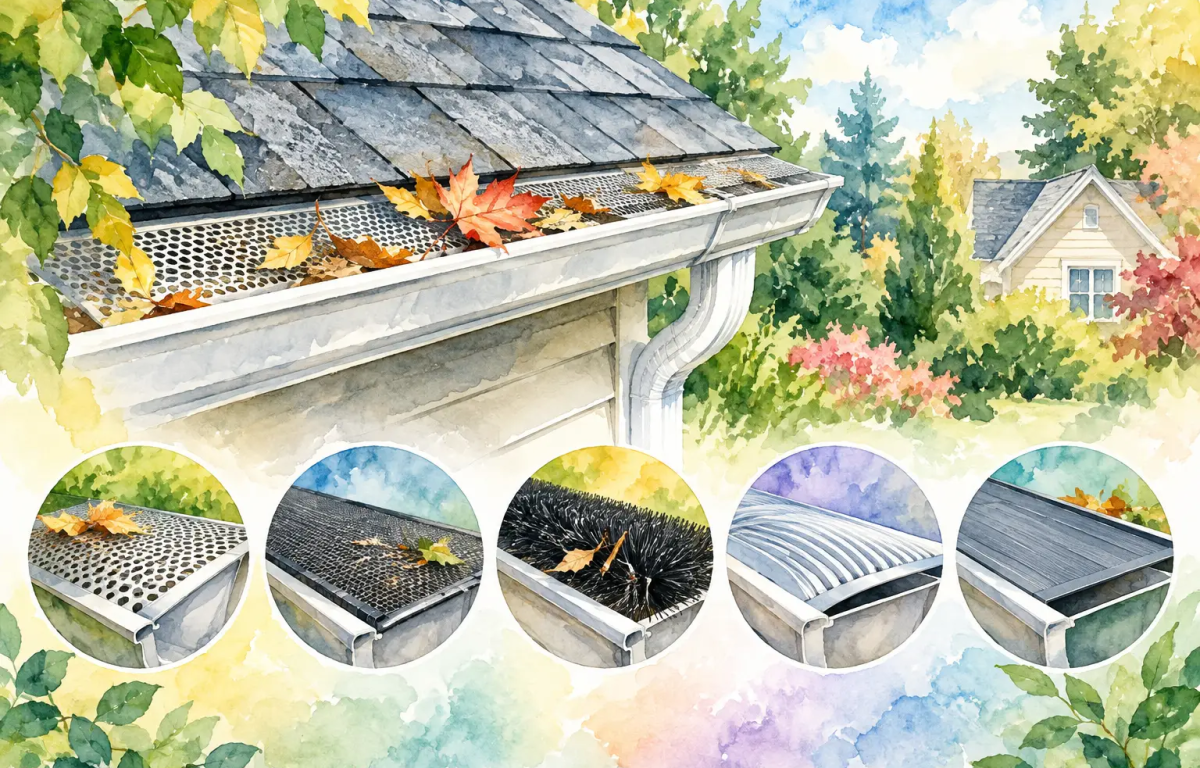
Screen guards are one of the most common and affordable options. They sit over the top of the gutter and use larger openings to block leaves, twigs, and other obvious debris. Many are made from aluminum, vinyl, or steel.
They can be a practical choice for homes surrounded mostly by broadleaf trees. Their larger openings allow water to enter easily, even during a strong downpour. The trade-off is that pine needles, seed pods, and roof granules may still pass through or rest on top of the screen. They often require occasional brushing or rinsing to keep the surface clear.
Micro-mesh gutter guards
Micro-mesh guards use a much finer metal screen, usually stainless steel, to block smaller debris while allowing water through. This is often one of the strongest choices for homes near pine trees or properties that collect shingle grit after storms.
The finer mesh can reduce the amount of material that reaches the gutter interior, which means less frequent cleaning. Quality matters here. A well-supported micro-mesh system should sit securely, resist sagging, and be installed so it does not interfere with the roof edge or shingles. Cheaper mesh products may clog on top or pull loose after severe weather.
Reverse-curve gutter guards
Reverse-curve guards, sometimes called surface-tension guards, use a solid cover with a curved front edge. Water follows the curve into a narrow opening, while leaves and larger debris are intended to fall away.
This design can work well against larger leaves, but it needs precise installation. If the angle is wrong or the system is not matched to the roof and gutter profile, heavy rain can overshoot the opening. Because Upstate storms can bring sudden, intense rainfall, water-handling performance should be evaluated carefully before choosing this style.
Foam inserts and brush guards
Foam inserts fit inside the gutter, while brush guards resemble large pipe cleaners that sit in the channel. Both are simple to install and can keep larger leaves from filling the gutter.
They are usually lower-cost options, but they do not stop debris from entering the gutter completely. Fine particles can settle into the foam or brush material, and organic buildup can hold moisture over time. These products may make sense as a short-term solution, but they generally require more hands-on maintenance than a quality screen or micro-mesh system.
Solid hood gutter guards
Solid hood systems cover most of the gutter opening and direct water through a narrow intake channel. They offer a clean finished look and do a good job blocking leaves and limbs from entering the gutter.
As with reverse-curve designs, installation is critical. The hood must be positioned for the roof’s pitch, the gutter size, and the volume of runoff expected during a storm. A guard that looks good but cannot keep up with rainfall is not protecting the home the way it should.
Your Roof and Trees Matter More Than the Sales Pitch
The best guard for one home may be the wrong choice for the house next door. A ranch home with a moderate roof pitch and several oak trees has different needs than a steep-roofed home beneath tall pines.
Pine needles are one of the biggest deciding factors. Larger-hole screens can catch leaves but allow needles to enter, while some solid covers may let needles gather along the front edge. A durable micro-mesh guard is often better suited to fine debris, provided it is installed with enough support to handle wind and rainfall.
Roof runoff also matters. Larger or steeper roofs shed water quickly. During a storm, that water reaches the gutter with force. If the gutter is undersized, loose, improperly pitched, or already clogged with roof grit, adding guards alone will not solve the problem. The system may need repair, reinforcement, or replacement before guards are installed.
Do Gutter Guards Eliminate Cleaning?
No gutter guard eliminates maintenance entirely. The goal is to reduce the amount of debris entering the gutter and make cleaning less frequent, not to promise a maintenance-free system.
Leaves can collect on top of nearly any guard, especially in valleys where two roof slopes meet. Pollen, shingle granules, and storm debris can also build up around downspout openings. A visual check after major storms and during fall leaf drop is still smart. If water is spilling over the front of the gutter, running behind it, or pooling near the home, it is time for an inspection.
For homeowners who have experienced storm damage, this check is especially important. Wind can loosen gutter hangers, bend sections of metal, or knock guards out of place. A guard that is partially detached can become another source of trouble during the next heavy rain.
Installation Quality Protects the Roofline
A gutter guard should never be installed in a way that compromises the roof. Improper fasteners, poor placement near shingles, or incorrect attachment to fascia can create avoidable problems. This is one reason professionally installed guards are often worth considering, particularly on two-story homes or roofs with complex lines.
Before adding guards, inspect the full drainage path. That includes the condition of the fascia and soffit, gutter slope, hanger spacing, seam integrity, downspout placement, and discharge area at ground level. Water needs a clear route from the roof to a location away from the foundation.
At Extreme Roofing, a gutter project is approached as part of the home’s larger exterior system. If storm damage, roof wear, or failing trim is contributing to drainage issues, those concerns should be identified before the guard installation moves forward. A written proposal and clear scope help homeowners understand what is being repaired, replaced, and protected.
Choosing the Right Option for Your Home
Start with the debris your property produces. Homes with mostly large leaves may do well with a quality screen or solid-cover design. Homes under pines or near trees that shed fine material often benefit from micro-mesh.
Then consider water volume. If your roof sends a large amount of runoff into a short gutter run, prioritize a guard and gutter combination built to handle heavy rain. Do not select a product based only on the promise that it will never clog.
Finally, consider the condition and age of the existing gutters. Installing premium guards over sagging, leaking, or poorly pitched gutters can waste money. In some cases, replacing the gutters and adding guards at the same time provides a cleaner result and better long-term protection.
The right choice is the one that keeps water moving where it belongs, even after a hard Upstate South Carolina storm. A careful inspection now can prevent the soaked fascia, stained siding, and foundation concerns that often show up after the next round of rain.