
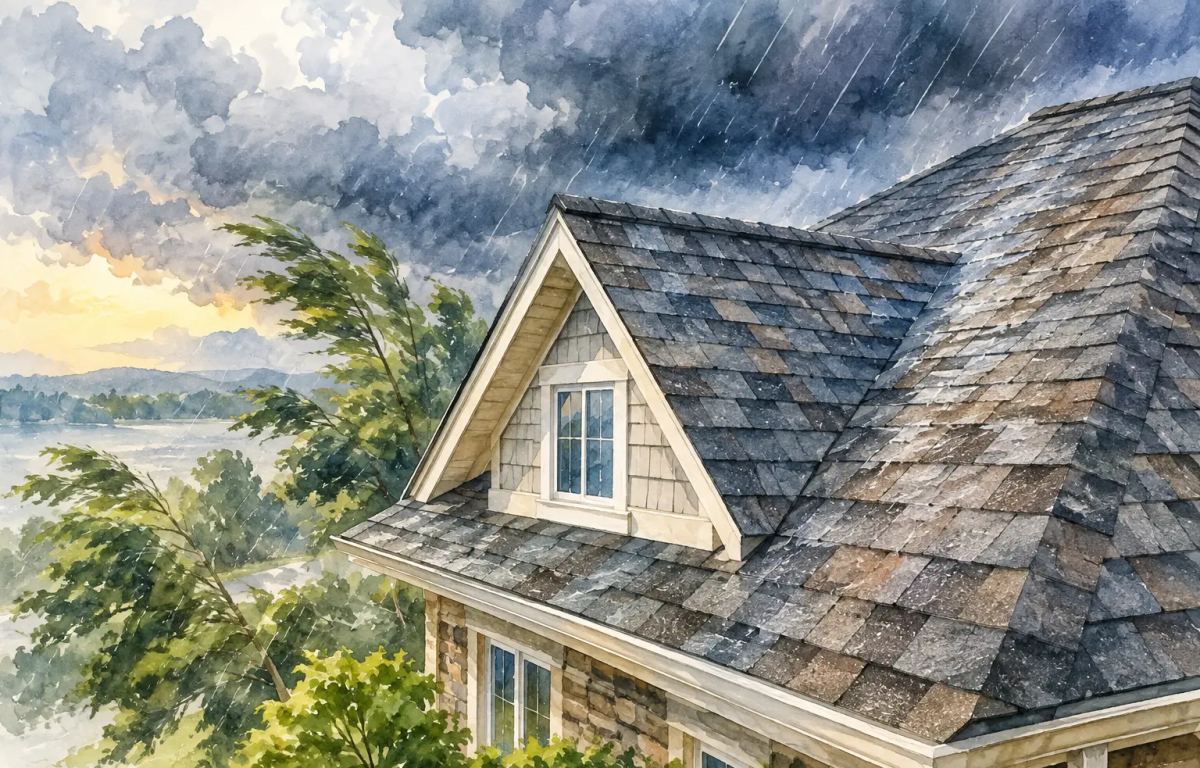
A roof can look perfectly fine from the driveway after a hard storm and still have damage that shortens its life. This architectural shingles storm performance review looks at what these popular shingles can handle, where they can fall short, and what Upstate South Carolina homeowners should inspect after high winds, hail, and heavy rain.
Architectural shingles are a common choice because they offer a thicker, layered appearance than basic three-tab shingles without moving into the cost of metal, slate, or tile. They can be an excellent fit for homes in Laurens, Greenville, Anderson, Greenwood, and Spartanburg, but storm performance depends on more than the shingle printed on the estimate. The installation, roof ventilation, flashing, decking condition, and age of the roof all matter when severe weather arrives.
How Architectural Shingles Hold Up in Storms
Architectural shingles are also called dimensional or laminated shingles. Their multiple bonded layers give them more weight and depth than a standard three-tab product. That extra construction can improve wind resistance and help the roof maintain its appearance over time.
For a homeowner, the practical benefit is that a quality architectural shingle system generally has a better chance of staying sealed during ordinary wind events. Many products are rated for winds around 110 to 130 mph when they are installed according to the manufacturer’s requirements. Those numbers are useful, but they are not a promise that a roof will never be damaged.
Wind does not hit every part of a roof equally. It pulls hardest at ridges, rakes, eaves, valleys, and around penetrations such as pipes, vents, and skylights. A shingle may remain intact across most of the roof while a small lifted section near an edge creates the leak that damages a ceiling. That is why a post-storm inspection should look beyond missing shingles.
Wind Resistance Depends on Installation
A wind rating applies to a complete system installed under specific conditions. Correct nail placement is a major factor. Nails driven too high can miss the shingle’s reinforced fastening area. Nails driven too low may leave part of the shingle loose. Overdriven nails can cut into the shingle, while underdriven nails can keep the next course from sealing flat.
Starter shingles, properly sealed ridge caps, compatible underlayment, and secure flashing also matter. So does the roof deck underneath. If decking is soft, water-damaged, or poorly fastened, the roof may not hold up as expected when wind pressure builds.
This is one reason the lowest bid is not always the best value after storm damage. A roof replacement should be priced around the full system, not just the visible shingles.
Architectural Shingles and Hail Damage
Hail is where an architectural shingle storm performance review needs the most context. Thickness can help architectural shingles resist minor impacts better than lighter shingles, but no asphalt shingle is immune to hail. The result depends on hail size, speed, density, roof slope, age, and the temperature at the time of impact.
Hail damage is not always a dramatic hole or a missing piece of roofing. On asphalt shingles, it often appears as a bruised area where granules have been knocked away and the asphalt mat has been weakened. The mark can be subtle, especially from the ground. A roof may still shed water today, yet exposed or fractured areas can age faster and become more vulnerable to future rain and wind.
Impact-resistant shingles are available and are commonly classified as Class 3 or Class 4 under a standardized impact test. A Class 4 shingle may be worth considering for homeowners who have experienced repeated hail losses or want added protection at replacement time. However, impact resistance is not the same as hail-proof protection. It also does not eliminate the need to inspect gutters, metal flashings, screens, siding, and soft metals after a storm.
If you are evaluating a claim, avoid relying on a few photographs alone. A trained inspector should document the full roof and related exterior damage, identify storm-created issues versus normal wear, and provide clear findings you can use when speaking with your insurance carrier.
Heavy Rain Exposes Weak Points Fast
Rain usually finds an installation issue, old flashing detail, or damaged roof component before it finds its way through an intact shingle field. Architectural shingles shed water well when installed correctly, but they are only one layer of protection.
Common leak locations after storms include chimney flashing, pipe boots, valley areas, wall-to-roof transitions, skylights, and improperly sealed nail holes. Clogged or damaged gutters can add to the problem by allowing water to back up at the roof edge or overflow against fascia and siding.
Inside the home, look for ceiling stains, damp insulation, peeling paint, a musty odor in the attic, or water near light fixtures. Do not assume a stain is old just because it is dry when you notice it. Water can travel along framing and appear several feet from the actual entry point.
What a Real Roof Inspection Should Cover
After a severe storm, homeowners should be cautious about climbing onto the roof themselves. Wet shingles, steep slopes, and hidden damage create a real fall risk. A professional inspection should be methodical and include the entire exterior, not just the spot where a leak appears.
A thorough storm inspection evaluates shingles for lifting, creasing, granule loss, impact marks, missing tabs, and exposed fasteners. It also checks ridge caps, valleys, flashing, vents, pipe boots, skylights, gutters, downspouts, siding, trim, and visible decking concerns. In the attic, signs of moisture, daylight, inadequate ventilation, and damp insulation can provide important clues.
Documentation matters just as much as detection. Clear photos, measurements, notes on affected elevations, and a written scope help homeowners understand the recommended work. They also make it easier to have an informed conversation with an insurance adjuster if storm damage may be covered.
When Repair Makes Sense and When Replacement Is Safer
Not every storm-damaged architectural shingle roof needs to be replaced. A localized repair can be the right call when damage is limited, surrounding shingles remain flexible and in good condition, and matching materials are available. Replacing a damaged pipe boot, resealing flashing, or repairing a small wind-lifted area may stop a leak and preserve the rest of the roof.
Replacement becomes more practical when damage is widespread, the roof is nearing the end of its expected service life, shingles are brittle or heavily granulated, or repairs would be scattered across several slopes. It can also be the better long-term decision when a prior repair would create obvious color and texture mismatches.
Insurance coverage is separate from the repair-versus-replacement decision. Coverage depends on the policy, deductible, documented storm damage, and the carrier’s assessment. A dependable contractor can help gather evidence and explain the scope, but should not promise an approval or tell you what your insurer will decide.
Choosing Architectural Shingles for an Upstate South Carolina Home
The best shingle is the one that fits the home, budget, roof design, and weather exposure. For many local homeowners, a quality architectural shingle offers a practical balance of curb appeal, wind performance, and replacement cost. Choose a color that works with the siding and brick, but give equal attention to the system details that will not be visible after installation.
Ask what starter material, underlayment, ridge cap, flashing approach, and ventilation plan are included. Ask whether damaged decking will be replaced if discovered and how the crew will protect landscaping and clean up nails afterward. Those answers say more about the quality of the project than a shingle color board ever will.
Extreme Roofing helps homeowners across Upstate South Carolina assess storm damage, prepare clear repair or replacement recommendations, and manage exterior restoration from inspection through final cleanup. The goal is simple: stop leaks, protect the home, and make the next storm less stressful than the last.
If your roof has been through hail, high winds, or a hard-driving rain, do not wait for a visible ceiling leak to decide whether it needs attention. A timely inspection can catch small failures while a targeted repair is still possible.